

| |
|
Located
in the heart of the Kentlands,
Dr. Sherman’s podiatry practice is easily
accessible with free parking only
a short distance from the door. |
Dr.
Sherman’s Potomac, Maryland location
at 10000
Falls Road. |
Podiatry is a field of medicine that strives to improve the overall
health and well-being of patients by focusing on preventing, diagnosing,
and treating conditions associated with the foot and ankle. Doctors
of Podiatric Medicine (DPMs) are physicians and surgeons who practice
on the lower extremities, primarily on feet and ankles.
For more information about podiatry, click
here to visit the American Podiatric Medical Association.
| Doctor
Sherman is an expert in
non-invasive Extracorporeal shockwave therapy (ESWT)
for chronic heel pain. Dr. Sherman treats a wide array of
foot problems ranging
from rheumatoid arthritis to Diabetic Foot Care. |
Dr. Jon M. Sherman was born and raised in Rockville, Maryland and graduated
from the Bullis School. He is a graduate of The University of Wisconsin-Madison
and graduated with honors from Temple School of Podiatric Medicine in
Philadelphia in 1998. He went on to a three year podiatric medicine
and surgical residency at Tenet-Elkins Park Hospital. Dr. Sherman is
a Fellow of the American College of Foot and Ankle Surgeons and a Diplomat
of The American Board of Podiatric Surgeons. His training has focused
on both invasive and non-invasive treatment from sports injuries, wound
care, and overall treatment of the foot and ankle. Dr. Sherman has served
as a consultant for the Penn Relays and Marine Corps Marathon.
Dr.
Jon M. Sherman is Board Certified, in Foot Surgery, by the American
Board of Podiatric Surgery. Dr. Sherman is also a Fellow of the
American College of Foot and Ankle Surgeons.
American Board of Podiatric Surgery
American College of Foot and Ankle Surgeons
The Gaithersburg Foot and Ankle Surgery Center is
a fully accredited surgical center in Dr. Sherman’s office
Dr. Sherman has opened his own ambulatory surgery center, certified
and licensed by the state of Maryland. We found that we could offer
specialized procedures in a more informal setting at a fraction of the
cost associated with hospital surgery. Because outpatient foot surgery
is all that we do here, we have become extremely proficient at this
and our staff has done the procedures you may need hundreds of times.
We have all of the latest monitoring devices, operatory equipment and
do procedures under local anesthesia or intravenous or conscious sedation.
Our anesthesiologists are Board Certified and patients usually leave
within 30 minutes after the completion of their procedure. We have a
casual waiting room for family and friends. Parking is directly out
front and free.
Doctor Sherman offers all of the following podiatric services:
Comprehensive Foot and Ankle Care for All Ages
- Non-Surgical Treatment for Athletic Injuries
/ Ankle Sprains
- Endoscopic Heel Surgury
- Biomechanical Analysis and Functional Orthotic
Fabrication
- Shock Wave Therapy for Heel Pain (ESWT)
- In office surgical procedures now available
Medical Treatments of:
- Bunions / Hammertoes
- Heel Spurs / Arch Pain
- Non-Surgical Treatment for Neuromas
- Diabetic Foot Care / Including Infections
and Ulcerations
- Plantar Warts / Skin Conditions
Insurance plans accepted by Dr. Sherman:
MD-IPA/MAMSI/Alliance
Medicare
Blue Cross Blue Shield,NCA
Trigon/Tricare
NCPPO
|
Cigna,
Hmo& Ppo
Aetna HMO, PPO
United
PHCS
Great West PPO
|
Mailhandlers
First Health
Coventry
Fidelity
|
|
Pediatric Foot Disorders
Should I be concerned about the way my small child walks?
Parents are concerned about the well-being and growth of their
children. Often times the parent wore corrective shoes as a child
or now has problems with their feet or ankles and wonders if their
child will have the same fate.
Below is a list of common concerns, what is considered normal,
and when to seek our help. |
|
| Podiatrist
Jon Sherman, pictured here with his young patient, treats people
of all ages and is an expert "foot doctor." |
Flat Feet: This condition is often referred to as
pronation. All people pronate to some degree, but excessive pronation
can lead to problems such as bunions and heel pain in adults. A large
part of this tendency to pronate is inherited from the parents. It is
normal for children to be flat footed up until the age of 6 years because
of how the baby is positioned in utero and the development of the feet
and legs after birth. If your child is over 6 years old, has one foot
that is positioned much differently than the other foot, complains of
pain or night cramps, or if a family member has had problems due to flat
feet, you should see your podiatrist.
Toe
Walking: Toe walking can normally be found in early walkers. Children
should, however, start to walk heel to toe after 6 months of walking.
If toe walking persists, you should always see a podiatrist to rule
out an underlying neurological or musculoskeletal condition.
Bow Legs: At birth, infants have a small degree of bowing in
their legs because of their position in the womb. This condition is
usually temporary and the child will outgrow the bow legs by age 2 years.
If the child still has bowing past 3 years, you should see your podiatrist.
Knock Knee: Knock knee is also a part of normal development
of a child's growth. This condition usually starts at about age 2 and
reaches its maximum at about age 4 years. It tends to disappear at age
6 or 7 years. If this condition is accompanied by foot, ankle, or knee
pain or excessive tripping, or one leg looks much different than the
other, see your podiatrist.
In-Toeing: The tendency to be in-toed (pigeon toed), like many
of the previous conditions discussed, is inherited from the parents.
A mild degree of in-toeing is perfectly normal. In fact, many professional
athletes in-toe. Many children will outgrow this tendency by age 7 or
8 years. Some in-toeing is due to the position of the foot bones at
birth. If your child is born with his or her toes pointed in and the
foot forms a "C" shape when viewed from the bottom, seeing your podiatrist
earlier may make it easier to correct this condition. When your child
is older, if they trip often or complain of foot or leg pain, see your
podiatrist.
When these treatment options are no longer providing the comfort you
need, consultation with your podiatric physician is advised to discuss
surgical options.
High Heels
Alternating high heels with lower ones enables your physique to adapt
and benefit from the plus-points of all heel heights.
According to podiatrist Jon H. Sherman, totally flat shoes are not
the ideal for overall health of the feet or legs: a small heel is better.
"Low
heels of half to three quarters of an inch are good for both the front
and back of the foot,"
he says.
"Small
heels not only help reduce tension in tendons and ligaments around the
foot, they also help the calf muscles - which are tight in many women
- to relax."
Higher heels (11/2in-21/2in) are best worn for limited
periods, say around three to eight hours, providing you are having sitting
breaks for half that time. At other times, wear lower heels.
Chronic Heel Pain
Having a bad foot day?
You may be surprised to know that your feet are not supposed to hurt
and most foot problems can be resolved with early medical intervention.
If you are having a foot problem, you are not alone; twenty percent
of the population seeks help for a foot problem every year.
Shocking good news for chronic heel pain
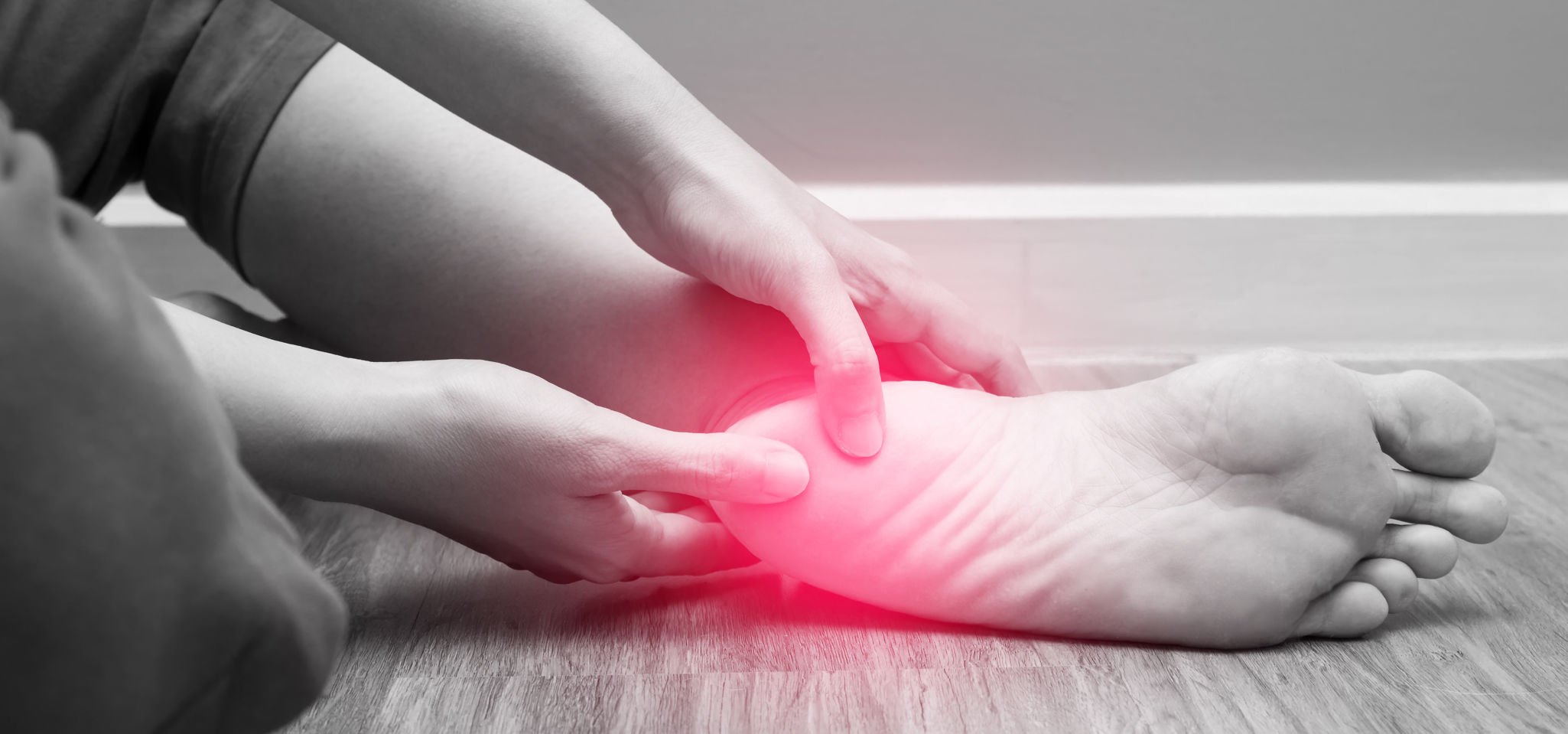
Do you or someone you know have chronic heel pain? This condition is
known medically as Plantar Fasciitis.
If your answer is yes to the above question, you may be interested
in a relatively new alternative treatment called extracorporeal
shock wave therapy (ESWT), a non-invasive procedure in which
strong sound waves are directed at the area of pain. The device used
for ESWT is very similar to the one currently used in non-surgical treatments
of kidney and gall-bladder stones. This device generates strong shock
waves at the treatment site. The ESWT treatment takes about 30 minutes
and is performed under local anaesthesia and/or 'twilight' anaesthesia.
ESWT is an out-patient procedure and does not require an overnight stay
in the hospital.
In the U.S. alone, about two million cases of heel pain are reported
each year and many are debilitating. ESWT has proven to be extremely
effective in treating such conditions as plantar fascitis, commonly
known as heel spurs. ESWT has also been used to treat tennis elbow and
Achilles tendonitis.
Heel Pain Syndrome and ESWT
Finally,
there's effective treatment for your chronic heel pain or other chronic
orthopedic conditions...without open surgery or lengthy therapy sessions.
Extracorporeal Shockwave Therapy (ESWT) is restoring patients with
chronic heel pain syndrome (Plantar Fasciitis) to a normal, active lifestyle
with a single treatment. A non-invasive procedure similar to lithotripsy
used in the treatment of kidney stones, ESWT uses therapeutic pressure
waves to relieve the pain and inflammation to the ligament on the bottom
of the foot.
With the FDA's approval of ESWT in 2001, hundreds of thousands of Americans
can now experience this effective technology that has been used internationally
for a decade to treat a variety of chronic musculoskeletal conditions.
Shockwave therapy uses high intensity sound waves to rid my patients
of severe debilitating heel pain.
What is ESWT?
Extracorporeal Shockwave Therapy, or ESWT, treats chronic heel
pain syndrome (Plantar Fasciitis) and other tendonitis conditions. It
is a non-invasive procedure in which therapeutic pressure waves are
directed at the area of pain. In the case of chronic heel pain, energy
is transmitted through electro-magnetic shockwaves and are directed
at the plantar fascia, the ligament running along the bottom of the
foot. The shockwaves stimulate a healing response in the affected non-healing
tissue. The result is a reduction in inflammation and pain from the
affected ligament.
Patients experience a short recovery period, often with few or no side
effects. Most patients experience relief from the pain right away, but
for others, the full results from a single treatment may be experienced
in one to three months. Results typically last forever.
Our participating podiatrists and orthopedists utilize our Extracorporeal
Shockwave Therapy (ESWT) services for a variety of podiatric and orthopedic
ailments, including plantar fasciitis. To learn more about Shockwave
Therapy, click here.

Diagnostic
Ultrasound
The Mindray DP-6600 is a state of the art diagnostic ultrasound unit
that I utilize in my office, in lieu of x-rays. The DP-6600 is utilized
for the diagnosis of tendonitis, plantar fasciitis, tendon ruptures,
soft tissue masses such as fibromas, bursitis, cysts and ganglions,
Morton's neuroma and other nerve tumors, capsulitis, plantar plate dysfunction,
foreign bodies, bone injuries such as stress fractures, muscular injuries,
ligament injuries, joint pathology and ultrasound guided injections
and aspirations.
The DP-6600 works via ultrasound waves and eliminates radiation exposure
to the patient.
BOTOX® for Hyperhidrosis
A
little sweat is a good thing. In fact, brain-imaging studies in humans
and neurochemical studies in animals have shown evidence that sweat
inducing exercise actually makes a stronger brain. However, in a society
that demands that you "never let them see you sweat," excessive
perspiration, known medically as hyperhidrosis, can have physiological
consequences such as cold and clammy hands, smelly feet and underarms,
dehydration, and skin infections secondary to maceration.
Excessive sweating increases anxiety and stress in both occupational
and social situations. There are even some “fiscal” consequences
as well, including ruined clothing and shoes. Read More Click
Here.
Sculptra
and Restylane: “Pillows For Your Feet”
- Do you suffer from hard, bony prominences on your feet?
- Is touching the floor barefoot painful?
- Do the balls of your feet burn?
As we age, fat is often lost under the ball of the foot. This lost
padding can be replaced with Sculptra or Restylane. Sculptra is made
up of microscopic particles of polylactic acid (the same material used
in some absorbable sutures). Restylane uses a form of hyaluronic acid.
Hyaluronic Acid is the same in all animal species and therefore has
a very low allergenic potential.
Call now for more information.
What is Extracorporeal Shock Wave Therapy or ESWT?
ESWT is a new procedure used to treat chronic heel pain syndrome and
other tendonitis conditions. It is a non-invasive procedure in which
therapeutic pressure waves are directed at the area of pain. The technology
has been used in the successful treatment of hundreds of thousands of
patients worldwide. One of the advantages of ESWT is that the risks
associated with open surgery may be avoided.
What can be expected when a patient has ESWT?
ESWT is a non-invasive procedure and is performed on an outpatient basis.
The procedure lasts approximately 30 - 45 minutes. During the treatment,
the physician targets and directs therapeutic pressure waves to the
affected area. The benefits of the treatment may take from one to three
months to be fully effective. Dr. Sherman will schedule continued care
visits and post-ESWT continuance therapy.
Is the ESWT procedure painful?
Prior to treatment, local anesthesia is administered to make the patient
more comfortable. Afterward, there may be temporary discomfort.
What happens after the procedure?
The ESWT procedure is performed on an outpatient basis. Each patient
is required to have a designated driver or guardian. Patients should
be able to return to normal daily activities after a brief recuperative
period. Consultation with Dr. Sherman will clarify any post-ESWT limitations
or specifics that may apply to your case. Dr. Sherman will schedule
continued care visits and post-ESWT continuance therapy.
Does insurance cover the treatment? Are there any other payment
options?
Extracorporeal shock wave therapy is gaining acceptance in the United
States by major insurance carriers. Patients should request coverage
for this therapy through Dr. Sherman's office or by directly contacting
their insurance carrier to determine reimbursement. Direct patient payment
and procedure financing may also be available.
Who is eligible for ESWT?
Generally, candidates for ESWT include patients with chronic heel pain
syndrome or other tendonitis conditions in which the pain has lasted
for more than several months without responding to conservative therapies
such as strengthening exercises, stretching, massage, splints, taping,
cortisone injections and anti-inflammatory medications.
What are the major advantages of ESWT (Extracorporeal Shock Wave Technology)
vs. older open heel pain surgery?
- There is no cutting with this procedure. There are no major complications
that you could get with ESWT surgery. ·
- Healing time with ESWT is 1,000 times faster. Heel spur surgery
can take six months or more to heal. ·
- There is no risk of permanent nerve damage or joint damage to the
foot with ESWT. ·
- No loss of time from work, which can occur with older open type
heel spur surgery. ·
- With heel spur surgery, you can have severe post-operative pain.
This doesn't happen with ESWT. ·
- "The most important reason to have ESWT over surgery is that you
can replace the money but you can't replace the complications that
possibly could occur with surgery."
Tips for Buying Shoes
RULE #1, buy a shoe that fits!!!!! Shoes do not have
to cost hundreds of dollars in order to be comfortable they simply have
to fit.
Every manufacturer sizes their shoes differently, so do not buy shoes
solely based upon the number imprinted in the shoe.
Buy your shoes at the end of the day after your feet have had a chance
to swell a bit. Wear or bring with you the sock you will be wearing
in that shoe. If you are wearing a dress sock or panty hose and try
on an athletic shoe when you would normally be wearing a thick athletic
sock, you may not get a good feel for the fit of the shoe.
If your feet have a tendency to swell, your best bet is a lace-up or
Velcro shoe. Slip-on shoes will not accommodate swelling. For more information,
click
here
Products
Dr. Sherman sells a wide variety of shoes and foot care products. Below
is a sampling of what is available. Please contact our office for an appointment
to see our entire collection and for a fitting.
Amerigel
The manufacturer AmerX Health Care says using the dressing reduces
healing time between 20 to 50 percent and eliminates patient soaking.
- Shoes
- Diabetic Shoes
- Birkenstock
Birkenstock Custom-Made Orthotic Sandals and Clogs are made from scratch
using genuine Birkenstock components. And as with all custom-made
devices, the process begins when you cast your patients using your
prefered neutral position casting technique and medium.
Custom
Made Inserts By Ortho-Rite
The Ortho-Rite Ultra is a one piece appliance manufactured from the
highest quality standards in the industry. The Ultra's one piece design
eliminates any post evulsion. The heel contact point is 1 mm thick
providing versatility for shoe fit. Patients in need of biomechanical
control when heel depth and shoe fit are of concern.
- Naot Natural Footwear
Flexibility, flair. Nestle into the softness and luxury of Naot shoes
and sandals. Feel the relaxation envelop your being as you slip into
the natural fit of Naot's stylish footwear.
 |
 |
Fitness and Your Feet, Click
Here
Contact Sports and Your Feet, Click
Here
Cycling and Your Feet, Click
Here
Sports and Your Children's Feet, Click
Here
Winter Sports and your Feet, Click
Here
Frequently
Asked Questions
What
do I do before my surgery?
Why was my foot taped?
Why was I given an injection?
Why was I given a splint to sleep in?
Why was I placed in a hard cast?
Why was I given crutches?
Why was I given a removable cast?
Why was I given a prescription for pills to treat my pain?
Why was I given a prescription for pills for my toenails?
Why was I given a prescription for a cream to treat my skin and/or
toenails?
What Do I Do Before My Surgery?
Preoperatively, we sometimes do blood work to make sure your body is
in good condition to recover. We also see you before the surgery to
review your alternatives, the possible risks and complications, recovery,
etc. We will also give you your prescriptions for pain and anti-inflammatory
medicines.
If your surgery is to be done under intravenous sedation or general
anesthesia, you are to have no food or drink eight or more hours before
surgery. That means no coffee, tea, etc. If you take medicines, be sure
to ask us what to do about that before your surgery. Also, for sedation
or general anesthesia cases, you are required to see your family doctor
or internist before the surgery to get clearance. (Local anesthesia
cases do not need this.)
Arrive for your case 60-90 minutes early, depending on where it is being
done.
Be sure to wear lose fitting clothing to fit over your bandages. Arrange
for someone to drive you home. Make sure your family, friends and neighbors
spoil you rotten during your recovery!
Why was my foot taped?
Many times, foot pain is caused by abnormal mechanics or, simply put,
the way your foot or ankle moves. Accordingly, in these situations,
pills or shots only treat your symptoms since they don’t address
the cause. When you stop the pills, or the shot wears off, the symptoms
come back.
When we feel your problem is mechanical, we put tape on your foot to
change the way it moves. If this relieves or temporarily resolves your
symptoms, we can then feel confident that you need some type of support
in your shoe to do the same thing. With the right type of support to
change the way your foot or ankle moves, your injury can heal. Accordingly,
be sure to pay close attention to when the tape felt the best or relieved
most of your symptoms. We use that information to decide if you need
custom or over-the-counter inserts or orthotics to treat your problem.
Why was I given an injection?
Swelling can create significant pain and lead to the breakdown of tissues.
To expedite relief, a cortisone injection can help to reduce inflammation
and break up adhesions or scar tissues that result from prolonged swelling.
Most cortisone injections can take up to three weeks to reach maximum
benefit.
Why was I given a splint to sleep in?
Heel pain can be caused or aggravated by a tight heel cord (Achilles
tendon). Splints can be used to stretch the Achilles tendon while you
sleep. The purpose is to stretch this and lessen the strain on the bottom
or back of the heel. Most studies show that these splints should be
used for six weeks to obtain maximum benefit. While they can be uncomfortable
at first, slowly increasing the time it is used usually provides benefit.
Why was I placed in a hard cast?
When tissues have been injured by trauma or surgery, movement can slow
or stop healing. In these cases, we use a hard cast to protect the foot
and ankle from movement and trauma. The cast must be kept dry and, in
some cases, off the ground. Watch out for tightness, numbness, calf
pain, or shortness of breath. These can be signs of trouble. Also, do
not use sharp objects to scratch any itching you may get while in the
cast.
Why was I given crutches?
Anytime an injury or surgery is significant enough to force the need
to be non-weight bearing, we dispense or prescribe crutches. If you
were given crutches, we let you know if any weight can be placed on
the injured or surgical part. Compliance with those instructions is
critical to a full recovery, as weight on a part that should be protected
can slow or stop healing.
Why was I given a removable cast?
Technology has made life easier for us in many ways. We now have removable
casts that can protect and allow healing with minimal disruption with
our lifestyles. You were given a removable cast because your fracture,
sprain, or injury needs some protection but not as much as that offered
with a hard cast or crutches. Remove the cast to bathe, drive, or sleep.
Otherwise, wear it all times so that you may return to your normal routine
sooner than later.
Why was I given a prescription for pills to treat my pain?
Mild to moderate swelling and pain can be treated with anti-inflammatory
pills. Take these regularly and at the dosage prescribed to obtain maximum
benefit. Stopping early or taking the medication irregularly can lead
to recurrence of your problem or unnecessary pain.
Why was I given a prescription for pills for my toenails?
Fungus in the toenails is a very difficult problem to treat successfully.
When the problem is significant enough, we use pills to kill the fungus.
It is important for you to make sure we know the name of every medicine
you are on to avoid interactions. It is also important for you to tell
us if you get any side effects. The medicine kills fungus as it is incorporated
into every new nail cell as they are made and from going into the nail
from the skin beneath the nail. It has been shown to stay in your nails
for up to nine months after you finish the pills, giving prolonged protection
against recurrence. To help to make sure you have no internal problems
from these pills, blood testing should have been done before you started
and then while you remain on the medicine.
Why was I given a prescription for a cream to treat my
skin and/or toenails?
In mild cases of fungal infections of the skin and/or nails, or if pills
are not in your best interest, we give topical medicines. Skin clears
up very nicely with this, but may require four to six months of use
as it takes 28 days to make new skin. Nails are much more difficult
to treat with topical medicines as they have a difficult time penetrating
beneath the surface. In these cases, we use the topicals to prevent
spread or worsening.
Directions to
60 Market St. Suite 202
Gaithersburg, Maryland 20878
From I-270 North
Take exit for W. Montgomery Ave (Rt. 28 West)
Right on Great Seneca Highway
Left on Kentlands Blvd.
At the first circle, turn right onto Market Street
Brand new building on the right hand side, second entrance next to Lowe’s.
From Quince Orchard Road
Left on Kentlands Blvd.
At the first circle, turn right onto Market Street
Brand new building on the right hand side, second entrance next to Lowe’s.
From Darnestown
From Quince Orchard Road (Rt. 124) turn right onto Kentlands Blvd.
At the first circle, turn right onto Market Street
Brand new building on the right hand side, second entrance next to Lowe’s.
|